
The future can only get better if we continue to break silos and work as integrated teams focussed on promoting national interests, recommends Sanjeev Nayyar.

'In the run-up to the summit, Trump had indicated that he might strike a nuclear deal in the course of a single meeting or over several days, but as it transpired, Trump departed Singapore soon after the meeting.' 'This raises questions if his aspirations for an ambitious outcome had been scaled back,' says Rajaram Panda.

Dhanteras, the prime minister said, has become even more special.
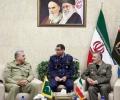
'Tehran senses that the Modi government is inexorably gravitating toward the US-Israeli-Saudi axis, jettisoning India's traditional independent Gulf policies,' notes Ambassador M K Bhadrakumar.

This is the third time that the two leaders are coming face to face, the last meeting being in May at Hanoi.

Proliferation and potential use of nuclear weapons pose the most dangerous threat to global security and peace, US President Barack Obama has said.

Thirty years after the massacre at Tiananmen Square, coerced collective amnesia envelops the Chinese nation about that horrific event. Claude Arpi glances back at how the student uprising could have changed the Middle Kingdom forever had the Chinese Communist party not traveled on the route of martial law.
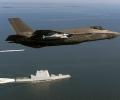
As the United States and China joust for supremacy, India might remain on the sidelines with its limited resources.

The two Koreas agreed during rare talks on Wednesday to form a combined women's ice hockey team to take part in next month's Winter Olympics in the South.
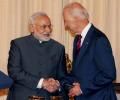
Prime Minister Modi needs to call Biden next month and clearly say: 'Mr President, the threat from China is clear and present. We, in New Delhi, have determined it to be an urgent national priority to outfit our submarines and aircraft carriers with nuclear propulsion and we want to cooperate with America on this programme",' advises Ajai Shukla.
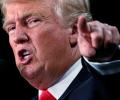
'If there is one certainty in this visit, it is that Trump does not follow a script. He is unpredictable,' highlights Ambassador B S Prakash.

'There appears to be greater convergence of interests between China and the US in the Afghan-Pakistan theatre than between India and the US. This is hardly a recipe for a super-alliance,' says former foreign secretary Ambassador Shyam Saran.

The bogey of the 1962 defeat must be laid to rest with a finality that is unquestionable. The myth of Chinese invincibility is a tall tale that belongs to an era gone by, says Vivek Gumaste.

'This is a historic juncture when the US is in great need of an alliance with India to strengthen its hands in the fierce struggle with China in the Asian theatre,' points out Ambassador M K Bhadrakumar.

The strategy, President Donald Trump said, is tailored and flexible to address the wide array of threats in the 21st century.

UAVs are an intrinsic part of today's technology driven battlefield. Indians don't seem to be taking the challenge with the degree of urgency that is required, says Brigadier S K Chatterji (retd).

"We have many relationships...they have a history. We will do what is in our national interest and part of that strategic partnership is the ability of each country to comprehend and appreciate the national interest of the other," Jaishankar said.

'Only when India's adversaries are convinced that India has both the necessary political and military will and the hardware to respond to a nuclear strike with punitive retaliation that will inflict unacceptable loss of human life and unprecedented material damage, will they be deterred,' says Brigadier Gurmeet Kanwal (retd).

The 8-km-long road show would start from the Ahmedabad airport and culminate at the Sabarmati Ashram.

Referring to Kim Jong-Un, Trump said 'Rocket Man', is on a suicide mission for himself and for his regime.

'One lesson to emerge out of the Modi-Putin summit is that India can be more self-confident that it possesses inherent strengths to leverage its interlocutors to influence Pakistani policies,' says Ambassador M K Bhadrakumar.

India's entry into the Wassenaar Arrangement would enhance its credentials in the field of non-proliferation despite not being a signatory to the Non-Proliferation Treaty.
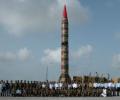
Saudi Arabia has invested in Pakistani nuclear weapons projects and believes it could acquire atomic bombs "at will", the BBC reported on Thursday.
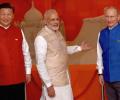
'With Pakistan's 'first use doctrine' threatening the use of nuclear weapons early in a war with India, the S-400 will shield vulnerable targets like Delhi and Mumbai, complicating Pakistan's targeting calculations.'

'If I had not been elected President of the United States, we would right now, in my opinion, be in a major war with North Korea,' Trump said.

'Nehru was singularly clear sighted about the international political situation.'
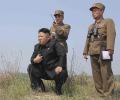
'Hardliners who are against denuclearisation may be working secretly on North Korea's nuclear activities, despite official claims that dismantling its nuclear arsenal has already begun.'' 'Does it mean that Kim does not have full control over the military,' asks Dr Rajaram Panda.
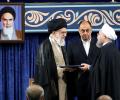
The Chabahar port, says Ambassador M K Bhadrakumar, 'can be the first significant footfall in an Indian variant of the 'Belt and Road' initiative.'

A proposed nuclear deal aims to stop Pakistan from building small tactical nuclear weapons that could fall into terrorist hands.

The White House said it has 'a large body' of evidence indicating that the Assad regime was responsible for the April 7 chemical attack in Duma.

'Bolstering India's conventional military capability against China is in America's strategic interest,' says military historian Colonel Anil A Athale (retd).
'I was present at a meeting where he decided to permit the IAF to strike at Pakistan positions in Kargil, with the caveat that they should not cross the LoC.' 'Confident that the Indian Army would succeed, Mr Vajpayee was positioning himself to tell the world after the Kargil conflict was won that India did not violate the 'sanctity' of the LoC,' recalls Ambassador G Parthasarathy, who served as India's envoy in Islamabad in that eventful year, 1999.

'The range of purchases throw a light on India's threat perception as also its perceived role of being a stabilising influence in the region,' says Brigadier S K Chatterji (retd).

'There is gradual rise in the number of nations viewing Pakistan as the nursery of global terror.'

'Imagine a scenario where a terror strike by Pakistan-supported jihadis causes thousands of deaths in India. India in retaliation destroys terror camps in Pakistan occupied Kashmir.' 'There is a clamour for revenge in Pakistan and that country begins to fuel its missiles for a nuclear strike against India and that is detected by Indian satellites.' 'No sane government in India will then wait for the nuclear bombs to fall on Delhi before launching its own strike. To be effective, this may well involve nuclear weapons.' Colonel Anil A Athale (retd) says the change in the 'No First Use' pledge in the BJP manifesto is long overdue.

During a 'Main bhi chowkidar' event, the prime minister also took a jab at the Congress about its minimum income poll promise and said that first-time voters should see the track record of those pitching for poverty.

Donald Trump, Hardik Patel, Kangana Ranuat... The year 2017 wouldn't have been the same if it weren't for these personalities and many more. As we herald in 2018, here's a look at the faces and stories which left an indelible mark on us.

The Indo-Japanese nuclear deal may not come easy considering India's Civil Nuclear Liability Act provisions which had earlier put off suppliers like General Electric, says Debalina Ghoshal.

20 years ago this day, May 11, 1998, India conducted its second nuclear test at Pokharan in Rajasthan. In a fascinating interview on Rediff.com, K Subrahmanyam revealed how Indian PMs reacted to nuclear ambitions.

From Hurricane Dorian to Hong Kong protests to Prime Minister Narendra Modi's mega event in Houston, Texas, United States -- these are the big moments that shaped the month of September.
